@quantfinancetogo's reel — transcript & breakdown
Plays
22.8K
Likes
490
Comments
1
Engagement Rate
2.16%
Create your own version
Use this post as inspiration to create your own
Audio
Calm, educational background music.
Caption
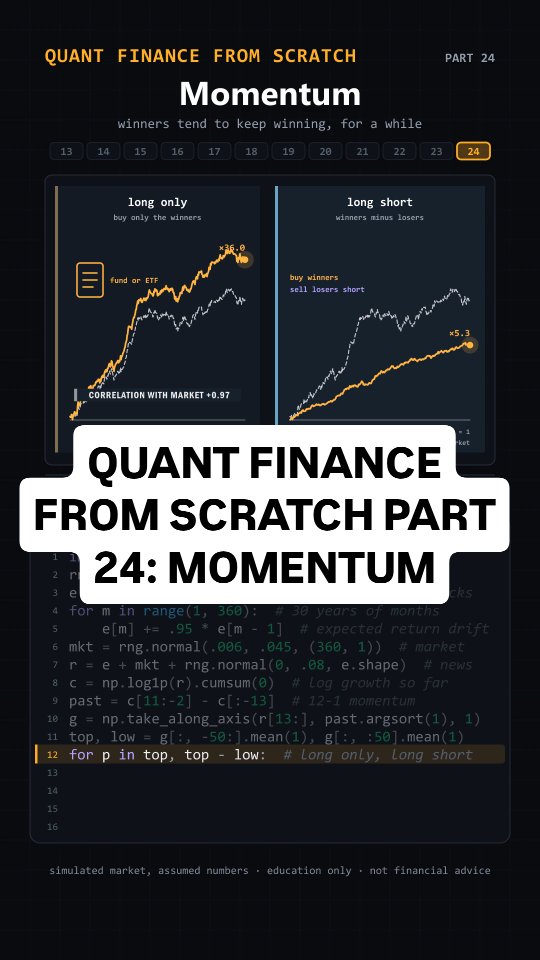
➡️ Quantitative Finance From Scratch, Part 24: Momentum. Momentum means that assets which rose the most over the past months tend to keep rising a little longer, and the biggest losers tend to keep falling. It is the opposite of mean reversion from part 23. Quants usually measure it as the return over the past 12 months, leaving out the most recent month, because very short moves tend to reverse. In research, a classic momentum portfolio ranks many stocks by this past return, buys the top group, sells the bottom group and repeats this every month. In practice there are two common versions: long only (you only hold the top ranked stocks, for example through a momentum fund) and long short (winners minus losers, so the ups and downs of the whole market largely cancel out). In this video we simulate 500 stocks for 30 years with a small built-in continuation: expected returns that drift slowly. The long short version earns 5.9% a year with a t statistic of 6.00 and a beta of -0.01 to the market. The long only version earns 13.7% a year, but with a beta of 0.99 it moves almost one for one with the market, which itself earned 10.5% a year in this simulated path. Momentum has been found in stocks, bonds, currencies and commodities, and in more than 200 years of stock data. It also has a dangerous side: after a market fall, a sharp rebound can lift the past losers fast, and momentum portfolios have had sudden, very large losses, for example in spring 2009. Some studies find it weaker and more volatile in recent decades, and trading costs eat a part of it, but it has not disappeared. All numbers come from one simulated run with assumed numbers (seed 24). No real market data, no strategy recommendation. Education only, not financial advice. #quantitativefinance #quant #momentum #factorinvesting finance
Details
Create your own version
Use this video as inspiration to create a new script
Hook
Why do winners keep winning in financial markets? It's called momentum.
Starts with a direct question and a visual demonstration of the core concept to immediately engage viewers interested in finance.
“Why do winners keep winning in financial markets? It's called momentum. One of the best documented effects in finance.”
Introduces the definition of momentum and contrasts it with a related concept (mean reversion) using clear visual aids.
“Momentum means that assets which rose the most over the past months tend to keep rising a little longer. And the biggest losers tend to keep falling. It is the opposite of mean reversion from part 23.”
Explains how momentum is measured and how portfolios are constructed to capture it, showing both the practical steps and code snippets.
“Quants usually measure it as the return over the past 12 months. In research, a classic momentum portfolio ranks many stocks by this past return. Buys the top group, sells the bottom group, and repeats this every month.”
Details two common implementation strategies (long only and long short), highlighting their differences in market correlation and potential returns.
“In practice, there are two common ways to implement it. Long only means you only buy the winners, for example through a momentum fund or ETF that holds the top ranked stocks. Long short means you also sell the losers short.”
Provides two behavioral explanations for why momentum works, appealing to viewer's understanding of market psychology.
“Why could it work? One explanation is that investors react too slowly to news, so prices adjust step by step. Another is that rising prices attract more buyers, so trends feed themselves.”
Reinforces the validity of momentum by citing extensive research across various asset classes and historical data.
“Researchers have found momentum in stocks, bonds, currencies and commodities, and in more than 200 years of data.”
Addresses the risks of momentum strategies, particularly during market reversals, to provide a balanced perspective.
“Momentum also has a dangerous side. When markets turn sharply, the losers can rebound fast, and momentum portfolios have suffered sudden very large losses.”
Summarizes the key takeaways about momentum, reiterating its importance and inviting viewers to learn more.
“In short, momentum means past winners tend to keep winning for a while. Quants measure it, build portfolios from it, and watch out for its crashes. Follow for more if you want to properly learn quantitative finance.”
Details
More viral reels, analyzed
 @culteapp3.1K40 MESSAGES POUR ORGANISER UNE RÉPÈTE ?View
 @rahul_.basavaraj831.3KSo, I make videos online which helps peopleView
 @clickbylakhan288.1KHello, editors. I'm giving you a normal video. You just need to do the color grading.View
 @ur.zarha2.4Mkisi aisi mainu Takya nighaan mainu Takya hoye dil sakeya geya pair de rakheya Mere dii rahiii Mere vass rahiiView
 @i5ubha274.4KSo, hello editor. My normal raw video de raha hoon. Aap log bas color grading karke dena. Jiska color grading badhiya hoga, bas usi ka collab hoga.View
 @adicstenia19.4M¿SABÍAS QUE...? COLGARSE A DIARIO...View