@youraveragetechbro's reel — transcript & breakdown
Plays
44.1K
Likes
953
Comments
13
Engagement Rate
2.19%
Create your own version
Use this post as inspiration to create your own
Audio
Calm lo-fi beat playing in background
Caption
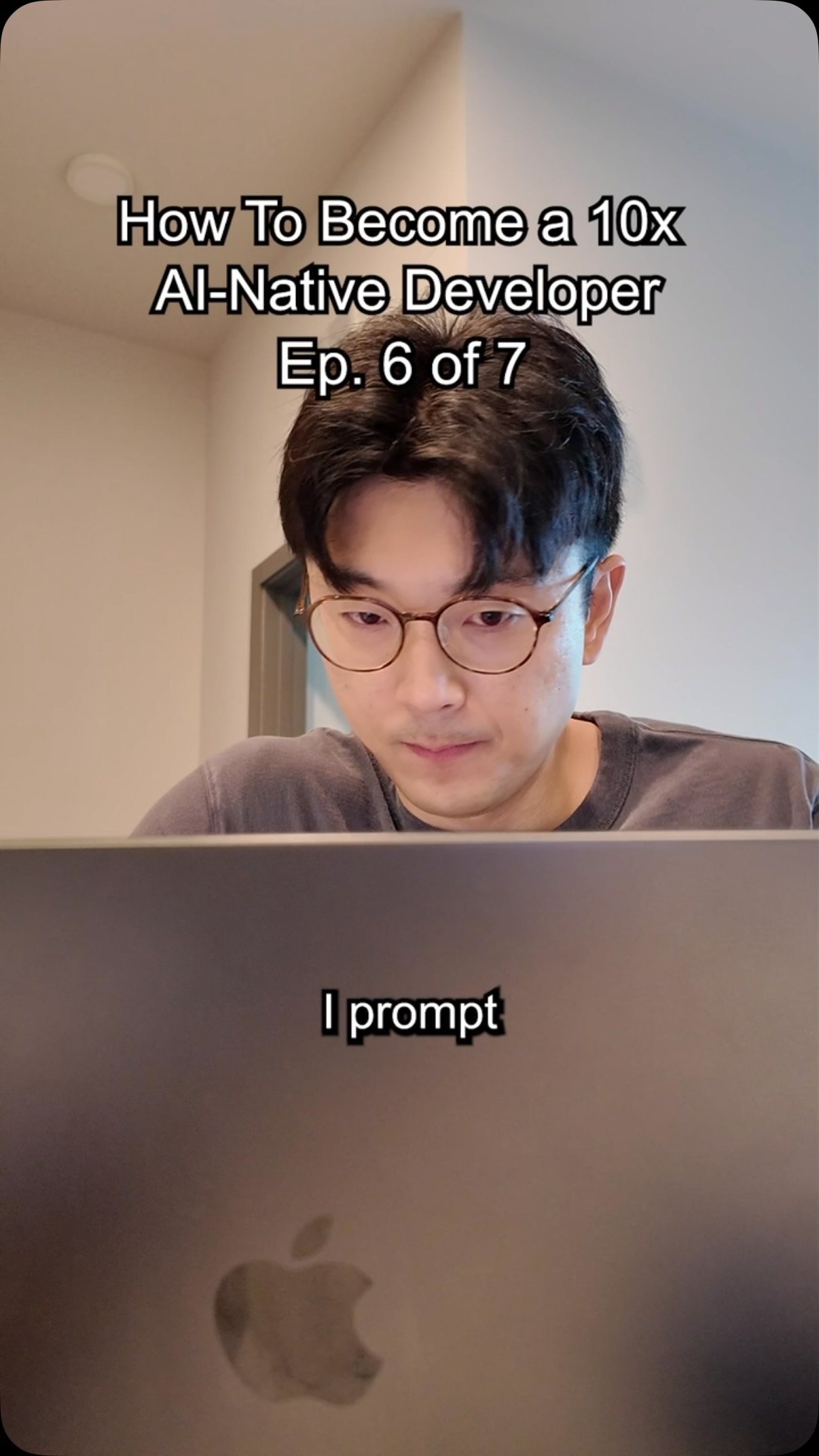
In this video, I talk about how I prompt AI to one shot bug-free features with relatively high confidence. This is episode 6 of seven in my how to become an AI native engineer series, and the big secret for one-shoting bug-free features at your confident in is front loading all of the engineering into the initial prompt writing. I like to separate the prompt into three distinct sections: number one is the goal of what I’m trying to achieve. Number two is the context section. I dump all necessary context, code paths, reference files, PRDs, ERDs, you name it. Anything that I possibly need to give to the agent to allow it to gather all the context that needs to implement the feature. And lastly, possibly the most important section is the validation and verification section where I list out all the verification scenarios that need to pass to consider this work completed. This built upon the verification skills that I talked about in the first video of this series. #coding #ai #developer 
Details
Create your own version
Use this video as inspiration to create a new script
Hook
This is how I prompt AI to one-shot bug-free features with high confidence.
The video starts with the speaker stating how he uses AI for bug-free features, immediately grabbing attention with a strong claim.
“This is how I prompt AI to one-shot bug-free features with high confidence.”
The speaker contextualizes the video as part of a series and briefly recaps previous topics, setting the stage for the current discussion.
“This is video 6 of 7 in my How to Become a 10x AI Native Engineer series. And in the first six videos, I talked about things like the importance of creating validation and verification skills.”
The core content of the video is introduced, focusing on the speaker's prompting strategy, structured into three distinct sections.
“And in this video, I want to talk about my prompting strategy about how to get really high results, relatively bug-free, with high confidence. And it really boils down to my prompt having three distinct sections.”
The speaker details the three key sections of his prompt: the bug fix/feature, the context section, and the validation/verification scenarios.
“Number one is listing out the bug fix or the feature that I'm trying to build. The second section is the context section. This is where I just dump every single piece of context that could potentially be helpful. All the file references, design docs, you name it, I guide the agent with as much reference material as possible to make sure that it knows where to look to implement a particular feature. And last but not least, arguably the most important part is I create a list of validation and verification scenarios that must pass to determine that this task is complete.”
The speaker elaborates on the benefits of this detailed prompting strategy, comparing it to delegating tasks to a junior engineer and stressing the importance of thoroughness.
“If anything, I'm still doing all the engineering, but all the engineering is front-loaded now in the initial prompt writing than me actually writing the code. It's not uncommon for me to spend 15, maybe even 30 minutes writing that initial prompt to really make sure it's clear, has all the right information, and most importantly, it has all the verification skills and all the edge cases that I need to consider. It's almost like you have a junior engineer that you're writing a ticket for, and you want to make sure that ticket has as much verbose context as possible, so your junior engineer that actually does the implementing doesn't make any mistakes and tries to write the code to your standard.”
A tweet from a Claude creator is shown, reinforcing the idea of avoiding laziness in prompting and emphasizing the value of precise instructions.
“And it actually reminds me about this one tweet that one of the creators of Claude has said, which is, 'I am most afraid of us eating the productivity gains of agents by just becoming lazier.'”
The speaker concludes by reiterating the core message: precise prompting leads to more effective and productive outcomes, even if it requires more upfront effort.
“So try your best to not be lazy with the prompts, because lazy prompting might work, but it's more effective and more productive to be very precise with what you're asking your agent to do with a very detailed prompt. And don't get me wrong, I'm not perfect. I don't do this all the time. Sometimes I do give vague tasks off to AI, and sometimes it works, but there's been multiple times where it has bit me in the ass and it ends up me having to rewrite the entire system so that I actually know what's going on.”
Details
More from @youraveragetechbro
View all
More viral reels, analyzed
 @wavestudio_ae19.7KLOOKING FOR THE PERFECT PLACE TO SHOOT YOUR NEXT PROJECT?View
 @garyvee8.0MWhy would you ever not be happy for another person?View
 @onelane_studios378.9KEverything I did in my 1-hour lunch break between meetings in LondonView
 @robertmckeaveney4.6MWhich video do you think got us more sales?View
 @larskuntz78.2KImmobilientipps aus dem FlugzeugView
 @nutrazenofficial85Every day at 2:17 PM, Arjun disappeared from his desk.View